Explore a team’s history.
A duo can look unbeatable for eight possessions. How does it look when you ask for more history? Or follow a player, a trio, or all five on the floor.
About this piece
A duo can look unbeatable for eight possessions. How does it look when you ask for more history? Or follow a player, a trio, or all five on the floor.
Duos and trios include time with other teammates on court. Opponents, roles, and sample size also matter. These comparisons identify questions to investigate; they do not isolate a combination’s causal effect.
A player across games.
Change the scale. Ask whether the apparent change reflects exposure.
The line describes this invented history. It does not establish development, predict future play, or adjust for role and opponent.
Every summary has a history.
Select a combination in the first view, then inspect its exact on-court stints and recorded events here.
How this experiment works
All figures come from one invented event ledger and exact-duration on-court stints. An explicit possession-end event supplies the exposure denominator. The complete synthetic stints have equal observed offensive and defensive possession counts. Net points per 100 = 100 × (points for − points against) ÷ offensive possessions. Assisted field-goal rate = assisted made field goals ÷ made field goals.
A separate incomplete capture is excluded from comparisons. No real children’s records, inferred activity minutes, live AI, or app backend are used. This is a new portfolio illustration of the value of durable history, not proof that every displayed comparison exists in the native app or improves coaching outcomes.
Keep the record.
Keep asking.
I’m building HoopSignal around a useful history of games: events, attribution, substitutions, and corrections. Its source includes pair, trio, and five-player analytics, plus history-scoped Player Growth.
The explorer uses an independent synthetic fixture with exact possession and time boundaries. The app’s estimated activity clock is a different method. Shared-floor comparisons include other teammates and are invitations to investigate context.
A recorded association is not an isolated causal effect or proof of an optimal lineup. No new real-game or device validation was performed for this portfolio experience.
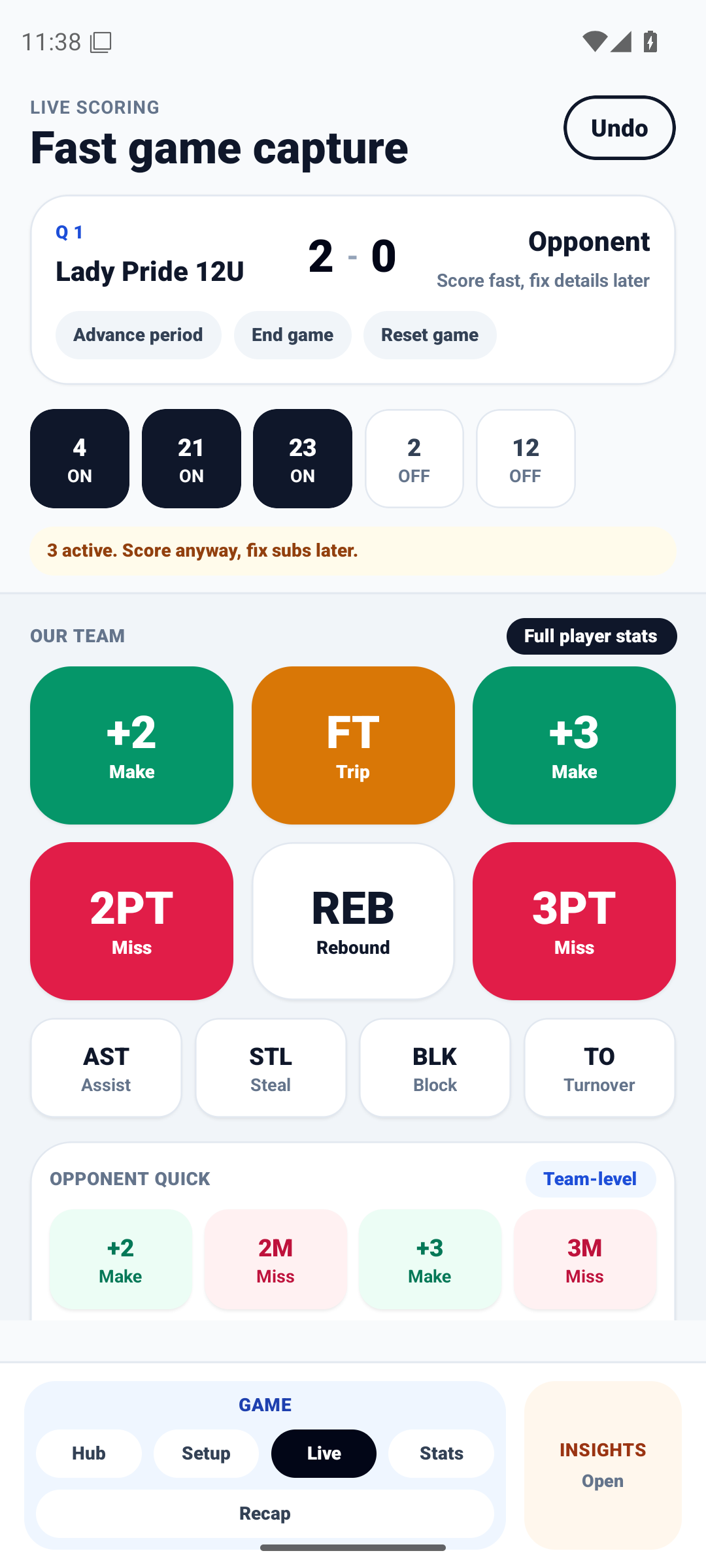
How it
helped me build.
Agent-assisted development and testing are documented in this project. The central design choices connect reliable capture and correction with a reusable history for combinations, development, and evidence-based questions.
What it
does inside.
Recorded game events support an offline recap. The source also implements an optional AI narrative interface, with validation and fallback. Authenticated live generation and narrative quality were not verified in this portfolio review.